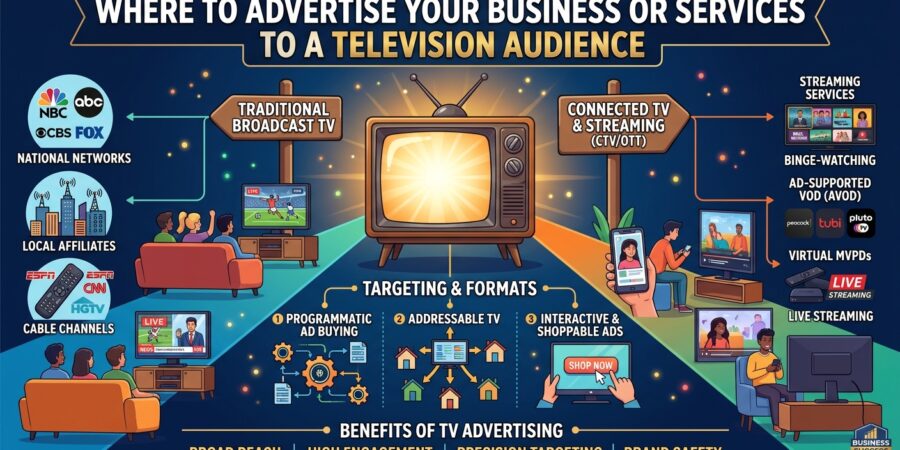
Discover effective strategies for advertising your business to a television audience through cable, broadcast, and streaming services.
Advertising your business or services to a television audience has changed drastically. While traditional cable and broadcast TV still exist, the rise of streaming has made TV advertising accessible and measurable for businesses of almost any size.
The primary pathways to reach a TV audience depend on your budget, geographic scope, and targeting needs:
1. Connected TV (CTV) & Streaming Platforms
- What it is: Ads shown on streaming services (like Hulu, Max, Peacock, Paramount+), Free Ad-Supported Streaming TV (FAST) channels (like Pluto TV, Tubi), or through streaming sticks and smart TVs (Roku, Amazon Fire, Samsung TV).
- Best for: Local, regional, or national businesses that want precise audience targeting (e.g., targeting by ZIP code, household income, interests, or online shopping habits).
- How to access:
- Self-serve & low-budget platforms: Services like Vibe or Trusted TV allow businesses to start streaming campaigns with low minimums (sometimes as low as $25–$50/day) without needing an ad agency.
- Direct Publisher Buys: You can buy ad space directly through self-serve portals offered by individual streaming networks.
- Programmatic Platforms: Utilizing Demand-Side Platforms (DSPs) to buy targeted inventory across various apps and channels automatically.
2. Traditional Linear TV (Local Broadcast & Cable)
- What it is: Commercial spots aired during scheduled programming on traditional network affiliates (ABC, CBS, NBC, Fox) or cable channels (ESPN, HGTV, CNN) via local providers.
- Best for: Businesses looking for broad local awareness within a specific Designated Market Area (DMA).
- How to access:
- Contact your local cable provider (e.g., Comcast/Xfinity Advertising, Charter/Spectrum Reach). They offer “zone-targeted” cable advertising, allowing you to display your commercial only to cable boxes in specific neighborhoods or ZIP codes.
- Work with a media buyer or advertising agency that has established relationships with local television station reps.
3. Advanced TV / Addressable TV
- What it is: A hybrid approach available through traditional cable providers (like Dish or DirecTV) and modern TV distributors. It allows you to beam different commercials to different households watching the exact same live television program based on household demographics.
- Best for: Hyper-local or niche-market service providers (e.g., HVAC companies, legal services, medical practices) who want the prestige of traditional TV without paying to show ads to uninterested viewers.
Key Steps to Get Started
- Define Your Audience & Geography: Decide whether you want to target everyone in a specific city/region or focus strictly on specific household demographics (e.g., homeowners, pet owners, parents).
- Produce Your Commercial: TV requires high-quality visual and audio production. Standard ad lengths are 15 seconds (for quick promos) or 30 seconds (the industry standard for a mini-narrative and call-to-action). Note: Many modern CTV platforms and agencies offer low-cost or AI-assisted video creation tools if you don’t have a pre-made commercial.
- Incorporate a Direct Response Mechanism: Because modern viewers often have phones nearby, include a QR code, a distinct vanity URL, or a text-to-action prompt in your commercial. This bridges the gap between TV viewing and immediate digital conversion.
- Track Outcomes: Unlike old-school TV where tracking was difficult, modern CTV platforms provide digital analytics—tracking metrics like completion rates, website visits, and customer actions resulting from the ad exposure.
Conclusion & Summary
Advertising to a television audience is no longer limited to large corporations with massive national media budgets. With the rapid growth of Connected TV (CTV) and addressable advertising, businesses of any size can now achieve the precise digital-style targeting of online ads combined with the high-impact, big-screen engagement of traditional television.
To choose the right path:
- Go with CTV and streaming platforms if you want hyper-local geographic or demographic targeting (e.g., targeting specific income brackets, interests, or ZIP codes) with low entry costs and measurable digital analytics.
- Choose traditional linear TV or cable zone-buys if your goal is broad, mass-market local awareness across an entire regional market.
By clearly defining your target audience, producing concise and engaging 15- to 30-second creative spots, and including direct-response elements like QR codes, you can successfully turn television viewers into active, trackable customers.